Home › Car buying › Car Deal Truth › Issue #1
The $2,569 room: where car dealers really make their money
Car Deal Truth · Issue #1
How much do car dealers make in the finance office?
About $2,569 per vehicle. That was the average F&I (finance and insurance) gross profit per vehicle retailed at America's publicly traded dealer groups in Q2 2026, according to the Haig Report. It's profit from arranging your loan and selling add-on products, and it's more than 40% above 2019's $1,798.
Source: Haig Partners, Q2 2026 Haig Report (publicly traded dealer groups; new and used vehicles).
Optional done-for-you help: VaultRubric's car-help service is $99 for Pro members and $149 for non-members. We can't promise any particular savings or outcome. Every deal, lender, and state is different.
Most people think the hard part of buying a car is haggling over the price. It's not. A big share of a dealer's profit gets made after you've agreed on a price. It happens in a small office down the hall, usually called "F&I" (Finance and Insurance) or simply "the box."
This first issue covers where that money comes from, what you can turn down, and what to say when you're sitting in that chair. Every number below links to a public source, and there's a full list at the end.
1. This week's number: $2,569
$2,569 was the average F&I gross profit per vehicle at America's publicly traded dealership groups in the second quarter of 2026. [1]
Some context:
- In 2019 the same figure was $1,798, so it has grown more than 40%. [1]
- The record was $2,627 in the first quarter of 2026. [2]
- In that same quarter, the profit these dealer groups made on the new car itself (the "front end") fell 15.8% from a year earlier, to $2,764 per new vehicle. [3]
In other words, the finance office now earns almost as much per vehicle as the sale of the car does.
A note on the numbers: These figures come from the Haig Report, published by Haig Partners, a firm that advises dealers on buying and selling dealerships. They're based on the large, publicly traded dealer groups, not every dealership in the country. The F&I figure counts both new and used vehicles sold, while the $2,764 front-end figure counts new vehicles only. [1][3]
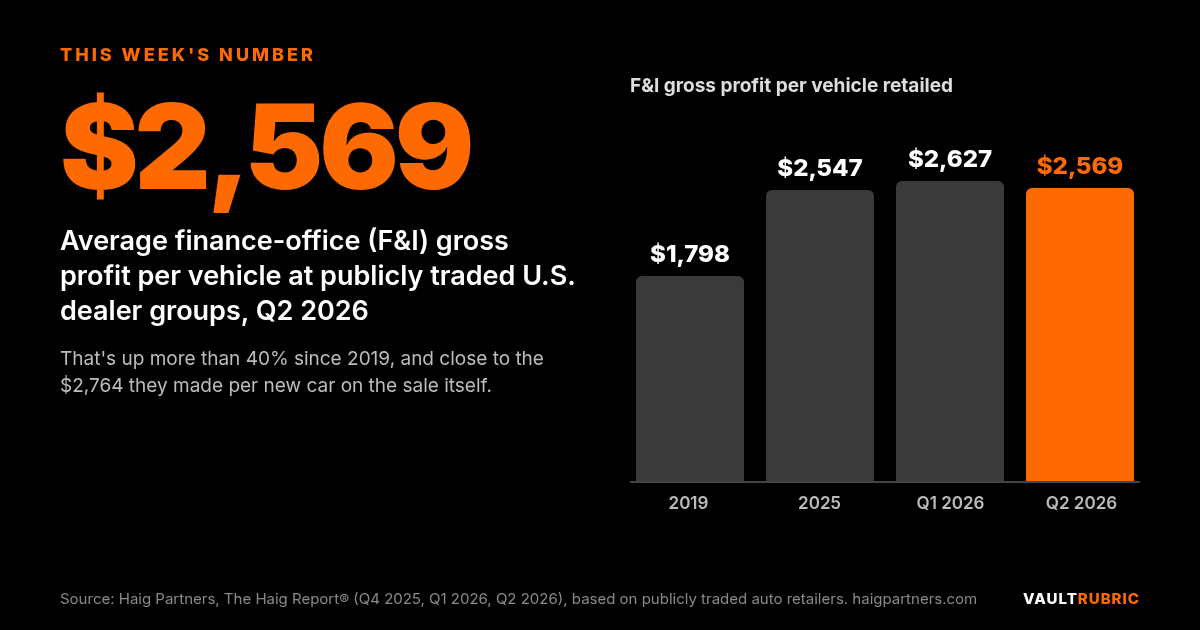
F&I gross profit per vehicle retailed, publicly traded U.S. dealer groups. Source: Haig Partners, Haig Report [1] [2].
2. Where the dealer's profit really is
A dealership makes money from a car deal in two places.
The front end is the car. It's the gap between what you pay for the vehicle and what the dealer paid for it. This is the number you spend an hour haggling over. In 2025 the average new vehicle at a franchised dealer sold for $48,205, according to the National Automobile Dealers Association (NADA). [4]
The back end is everything the finance office sells you after the price is set:
- Financing. The dealer arranges your loan and gets paid for doing it (more on this below).
- Protection products. Haig names vehicle service contracts (often called "extended warranties"), GAP coverage, and tire-and-wheel protection as the core F&I products. [2]
How "dealer reserve" works (the rate markup)
When you finance through the dealer, here's what the Consumer Financial Protection Bureau (CFPB), a federal agency, says happens: [5]
- The dealer sends your application to one or more lenders.
- Each lender tells the dealer the rate it will approve you for. That's called the "buy rate."
- The dealer chooses which offer to show you and may charge you a rate higher than the buy rate.
- When it does, the dealer "sells the loan to the creditor for more than the face amount you borrowed." In plain English, the dealer gets paid for that extra interest.
The CFPB's bottom line: "Yes, just like the price of the vehicle, the interest rate is negotiable." [5]
Is there a limit on how much a dealer can mark up a rate? No single nationwide rule appeared in the sources I checked. One real example: in a 2015 case with the CFPB and the Department of Justice, Honda's lending arm had allowed dealers to mark rates up as much as 2.25 percentage points on loans of 5 years or less and 2 points on longer loans. Under the settlement, Honda agreed to cut those limits to 1.25 and 1 point, or move to flat dealer pay. [6] That settlement covered one lender. It's not an industry-wide cap.
Haig's own Q2 2026 report says that higher borrowing costs "can expand finance reserve opportunity" for dealers. [1]
From my time in the business: The finance manager got paid mostly on back-end gross, meaning rate reserve plus the products they sold, and was tracked on profit per car and how often each product sold. Salespeople got paid on front-end gross, often a small flat amount when the deal had no profit in it. On a lot of new-car deals the front was close to nothing, and the store made its money in the finance office. Shane
3. Add-ons and fees you can say no to
According to the CFPB, "Add-on products and services are optional. You're not required to purchase them, but if you choose to, the price is negotiable." [7]
| Item | Required? | Negotiable? | Source |
|---|---|---|---|
| Vehicle price, including any "market adjustment" over sticker | Yes (it's the car) | Yes | [7] |
| Interest rate (APR), including any dealer markup | If you finance | Yes | [5][7] |
| Loan length (term) | Your choice | Yes. Shorter usually means less total interest | [7] |
| Extended warranty / service contract | No, optional | Yes | [7] |
| GAP insurance | No, optional | Yes | [7] |
| Credit life, disability, or debt-cancellation coverage | No, optional | Yes | [7] |
| Alarm, window tint, tire and wheel protection | No, optional | Yes | [7] |
| Dealer fees: doc fee, prep, delivery, origination | Charged by the dealer | Yes, per the CFPB. Some states cap the doc fee (see below) | [7] |
| Prepayment penalty on the loan | Ask | Yes. You can ask to have it removed | [7] |
| Sales tax, title, and registration set by the government | Yes | No | [7] |
Doc fees by state. Two examples:
- California caps the dealer's document processing charge at $85 (or $70 for dealers without a DMV partner agreement). The dealer can't present it as a government fee. [8] A 2025 bill to raise the cap was vetoed. [9]
- Tennessee sets no dollar cap in the law I reviewed. It allows dealers to charge a document preparation, processing, or service fee as long as the amount is listed separately, shown clearly on the contract or buyer's invoice before you sign, and not described as a government fee. [10]
Two more Tennessee rules worth knowing: [10]
- A dealer can be disciplined for requiring you to buy equipment or accessories you didn't ask for "as a condition of sale," unless it's the kind of equipment the manufacturer normally installs.
- If you drive off before the financing is final (a "conditional delivery"), the dealer has to give you a written conditional delivery agreement. If the terms change after you've accepted them, you're allowed to void the deal.
What happened to the federal "CARS Rule"? In January 2024 the FTC published a final rule aimed at bait-and-switch tactics and junk fees at car dealers. A federal appeals court (the Fifth Circuit) threw it out on January 27, 2025, and the FTC formally withdrew it effective February 12, 2026. [11][12] As of today, it's not in effect.
Why the paperwork matters:
- In a 2020 FTC staff study built on in-depth interviews with 38 recent car buyers, add-ons caused significant confusion. Buyers weren't sure whether add-ons were mandatory, and the FTC found "multiple instances" where a price that had already been negotiated was changed once the buyer reached the finance office. [13]
- In a 2023 order (which the CFPB terminated in May 2025), the CFPB said bundled add-on products financed by Toyota Motor Credit "averaged between $700 and $2,500 per loan," and that consumers had complained dealers lied about whether those products were mandatory. [14]
- The FTC uses the term "payment packing" for talking a buyer into a monthly payment larger than the agreed price requires, then filling the gap with add-ons. It used that term in a 2024 complaint against a dealer group. That complaint was dismissed in October 2026, and none of its allegations were proven in court. [15][16]
California update: CalMatters reports that a new California law (SB 766), taking effect October 1, 2026, requires dealers to disclose full costs up front, bans add-ons that give the buyer no benefit, and lets buyers return a used car under $50,000 within three days (dealers can charge a restocking fee). [9]
What I saw: Service contracts and GAP came first, then tire-and-wheel and appearance packages. They usually came on a menu with three or four packages, presented as a monthly payment difference ("only $18 more a month") instead of the total price. Shane
4. The rate markup math (worked example)
Here's what a markup can cost, using real current averages.
The inputs:
- Rate: 7.17%, the Federal Reserve's average rate on a 72-month new-car loan at commercial banks (G.19 release, August 2026 data, published October 7, 2026). The 60-month average was 7.54%. [17]
- Amount financed: $44,664, the average for a new vehicle in Q3 2026, according to Edmunds. [18]
- Term: 72 months
| Scenario | APR | Monthly payment | Total interest | Extra cost vs. 7.17% |
|---|---|---|---|---|
| No markup | 7.17% | $765.13 | $10,425 | none |
| +1 point markup | 8.17% | $786.82 | $11,987 | +$21.69/mo, about $1,562 total |
| +2 point markup | 9.17% | $808.87 | $13,574 | +$43.74/mo, about $3,149 total |
Payments use standard loan math and don't include taxes, fees, or add-ons. The +2 point row mirrors the 2-point limit Honda's lending arm allowed on longer loans before its 2015 settlement. [6]
What this example does not tell you:
- The Fed's 7.17% is a survey average of banks' most common rates. It isn't your buy rate, which depends on your credit, the vehicle, and the lender. [17]
- How much of the extra interest the dealer keeps is set by its contract with the lender, and that isn't public.
The bigger picture, from Edmunds (Q3 2026): [18]
- The average new-car APR was 7.0%.
- The average monthly payment hit a record $787.
- 21.2% of new-car buyers signed up for payments of $1,000 or more.
- 25.5% took loans of 84 months or longer.
- Average total interest over the life of a new-car loan reached a record $9,938.
How to spot it: Bring a credit union preapproval. If the dealer's rate is higher with the same credit, the difference is likely markup. And if the finance manager can suddenly "beat it" the second you show your preapproval, the amount they dropped was markup. Ask straight out: "What's the buy rate?" Shane
5. A 5-step script for the finance office
Print this or keep it on your phone. It's polite, short, and built on CFPB and FTC guidance.
Step 1: Walk in with your own loan offer. Before you shop, get preapproved by a bank or credit union. The CFPB recommends this, and says rate shopping within a short window (generally 14 to 45 days) counts as a single credit inquiry. [5]
"I'm preapproved at ___% for ___ months. If you can beat it, I'll finance with you. If not, I'll use mine."
Step 2: Ask about the buy rate.
"What rate did the lender approve me at, and is there any dealer markup in the rate you're showing me?"
They may not tell you. Asking still signals that you know how the system works. [5]
Step 3: Lock the price in writing before any products come up.
"Before we go over anything else, please print the itemized out-the-door price. I want to make sure it matches what I agreed to on the floor."
The FTC found negotiated prices sometimes changed in the finance office. [13]
Step 4: Decline the add-ons, out loud and on paper.
"I'm declining all optional products today. Please take ___ off the contract."
Add-ons are optional, and if you do want one, its price is negotiable. [7]
Step 5: Check the math, then read before you sign.
"Please walk me through how you got this payment: price, rate, term, and every line item."
Look at the total cost, not just the monthly payment. [7] Ask to see the full documents, not just signature boxes on a screen.
Shane's line to add: Negotiate the out-the-door price, never the monthly payment.
"I'm not discussing payments. What's the out-the-door price?"
"What payment are you looking for?" is the question that lets them hide everything else.
6. Want help with your next car?
Free: VaultRubric's car tools are at vaultrubric.com/auto. Use them to run your own numbers before you set foot on a lot.
Optional done-for-you help: If you'd like someone in your corner, VaultRubric offers a car-help service at vaultrubric.com/pro/car-help. It's $99 for Pro members and $149 for non-members. We can't promise any particular savings or outcome. Every deal, lender, and state is different.
If this issue was useful, forward it to someone who's car shopping.
This report is general education, not financial, legal, or investment advice for your situation. Laws differ by state and change over time. Check your own state's rules and read your contract.
Get Car Deal Truth by email
Free. One dealer-insider issue at a time, every number sourced. We'll email you a link to confirm first; one-click unsubscribe in every email.
Free tools need no account, SSN, or address. Most calculators run in your browser; a few send the numbers you enter to our server to do the math.
Email only. See our privacy policy.
Education, not advice. This report is general education, not financial, legal, or investment advice for your situation. Laws differ by state and change over time. Check your own state's rules and read your contract.
Sources
- Haig Partners, “Q2 2026 Haig Report: F&I Profits Remain Near Record Levels.”
- Haig Partners, “F&I Profits Reach an All-Time High in Q1 2026.”
- Haig Partners, Q2 2026 Haig Report press release (Aug. 19, 2026).
- NADA, NADA Data 2025 Annual Financial Profile. (overview)
- CFPB, “Can I negotiate a car loan interest rate with the dealer?”
- CFPB, “CFPB and DOJ Reach Resolution with Honda to Address Discriminatory Auto Loan Pricing” (2015). (consent order)
- CFPB, “What things can I negotiate when shopping for a car or auto loan?”
- California DMV, Vehicle Industry Registration Procedures Manual §3.030 (Veh. Code §4456.5).
- CalMatters, “Newsom vetoes car dealers’ bill to hike fees on buyers” (Oct. 2025).
- Tennessee Code §55-17-114 (2025), via Justia.
- U.S. Court of Appeals for the Fifth Circuit, NADA v. FTC, No. 24-60013 (Jan. 27, 2025).
- Federal Register, “Revision of the Negative Option Rule, Withdrawal of the CARS Rule…” (Feb. 12, 2026).
- FTC, “FTC Announces Staff Reports on Car Buying and Financing Experience, Results of Auto Buyers Study” (July 30, 2020).
- CFPB, “CFPB Orders Toyota Motor Credit to Pay $60 Million…” (Nov. 20, 2023; order terminated May 12, 2025).
- FTC, Asbury Automotive press release (Aug. 16, 2024).
- FTC, In the Matter of Asbury Automotive Group, case page (complaint dismissed Oct. 5, 2026).
- Federal Reserve, Consumer Credit G.19 (released Oct. 7, 2026).
- Edmunds, “New-Car Financing Records Pile Up in Q3…” (Oct. 1, 2026).
All figures re-checked against these sources on Oct. 17, 2026.
FAQ
How much do car dealers make in the finance office?
About $2,569 per vehicle. That was the average F&I (finance and insurance) gross profit per vehicle retailed at America's publicly traded dealer groups in Q2 2026, according to the Haig Report. It's profit from arranging your loan and selling add-on products, and it's more than 40% above 2019's $1,798. Source: Haig Partners, Q2 2026 Haig Report.
Can I negotiate the interest rate at a car dealer?
Yes. The CFPB says that, just like the price of the vehicle, the interest rate is negotiable. A dealer may charge you more than the lender's “buy rate” and get paid for the difference.
Do I have to buy dealer add-ons like GAP or an extended warranty?
No. The CFPB says add-on products and services are optional, and if you choose to buy one, the price is negotiable.
Estimates, not financial advice. Taxes, insurance, PMI and fees vary by lender, county and city; confirm with your lender, dealer and state agency before acting.